
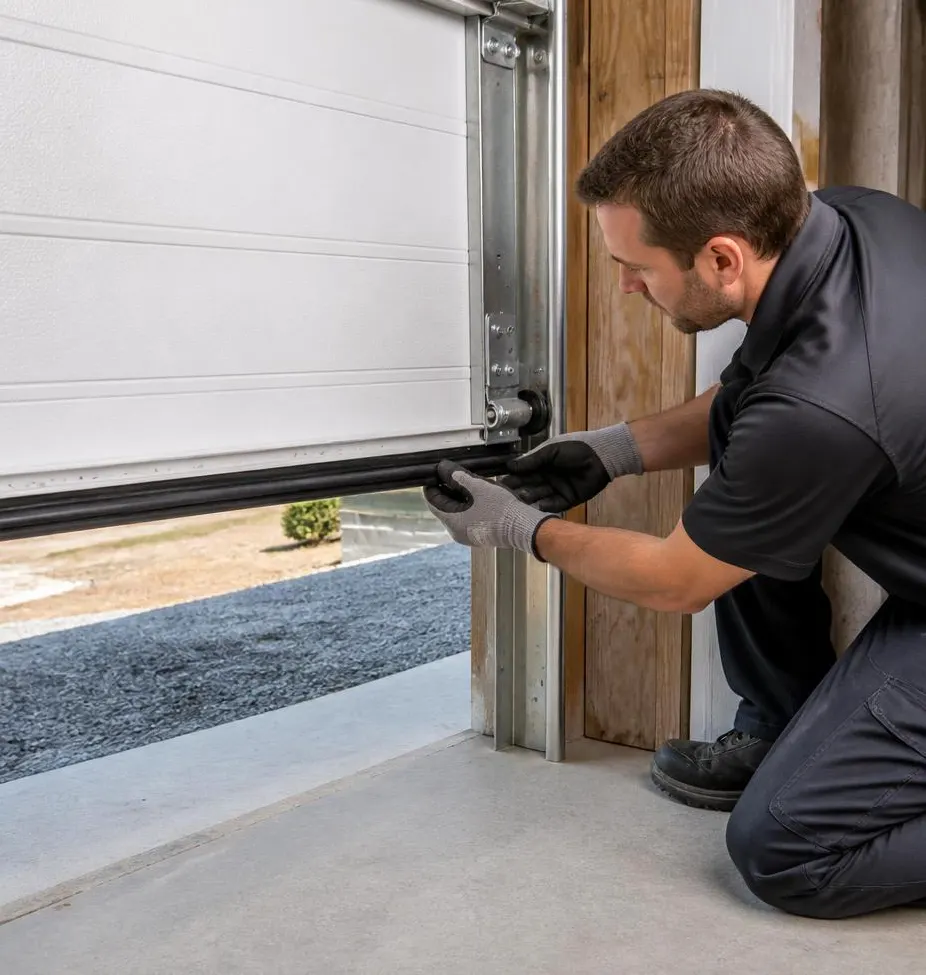
What a Technician Sees on This Call
A typical service call starts the same way: a homeowner noticed the door screeching on the way up, grabbed whatever was in the garage, and sprayed it on everything that moves. Usually that's WD-40, and usually it made things worse within a few weeks. WD-40 is a solvent, not a lubricant — it strips old grease, evaporates fast, and leaves a sticky film that grabs dust. After a summer of storm grit, pollen, and wind-blown dirt, that film turns into a gray paste on the rollers and tracks. By the time cooler weather sets in and metal parts contract slightly, the door is dragging, grinding, or binding somewhere along the track. The fix often isn't new parts — it's cleaning off the wrong product and doing the job right with the right one.
Tools You'll Need
- Step ladder tall enough to reach the top track safely
- Work gloves and safety glasses
- Clean, lint-free rags
- A small stiff brush (an old toothbrush works)
- Silicone-based or lithium-based garage door lubricant (sold as such, usually in a spray can)
- A flashlight for checking hardware in shadowed corners
Step-by-Step: Lubricating the Door
- Close the door and cut the power. Unplug the opener or switch off the breaker. Never lubricate a door that's mid-cycle or under spring tension you haven't accounted for.
- Inspect before you spray anything. Walk the full length of both tracks with a flashlight. Look for cracked rollers, frayed cable strands, rust on the springs, or a track that's visibly bent or pulling away from the wall. Note anything unusual — it matters for the next section.
- Wipe down the tracks and hardware dry. Use a rag to remove dust, cobwebs, and grit buildup, especially after a dry, windy stretch or a hailstorm that kicked up debris. Tracks should be clean and free of old, gummed-up lubricant before you add anything new.
- Lubricate the hinges. Spray a light coat on each hinge where the metal pieces pivot against each other, not on the flat panel surface.
- Lubricate the roller stems and bearings. Aim for the metal stem and bearing where it meets the hinge, not the nylon roller wheel itself. Nylon rollers don't need lubrication on their rolling surface and lubricant there just attracts grit.
- Give the springs a light, even coat. This reduces friction and rust but should be a light application — heavy coating just drips and collects dust.
- Lubricate the opener's drive rail or chain. Check your opener's manual; most chain and screw-drive units need a thin coat along the rail.
- Wipe off excess. Any lubricant left sitting in a puddle on a hinge or track will collect dirt within days.
- Restore power and cycle the door several times. Open and close it two or three times, listening for grinding, popping, or uneven movement. It should move smoothly and quietly after lubrication — if it doesn't, something mechanical needs attention beyond lubrication.
Products to Use — and What to Avoid
- Use: a lithium-based or silicone-based spray labeled specifically for garage doors. These resist temperature swings better than general-purpose products, which matters when summer heat gives way to the occasional ice event in this part of Oklahoma.
- Avoid WD-40 or similar penetrating oils as a long-term lubricant. Fine for loosening a stuck bolt, bad for ongoing lubrication.
- Avoid petroleum-based motor oil or household 3-in-1 oil. It's too thin, runs off quickly, and doesn't hold up to summer heat or dust.
- Avoid heavy grease on tracks. Tracks should stay clean and dry; grease there just collects grit and makes the rollers slip instead of roll smoothly.
- Never lubricate the rubber weatherstripping or bottom seal. It doesn't need it, and oil-based products can break the rubber down faster.
What's Safe for a Homeowner vs. What Needs a Technician
Cleaning and lubricating hinges, roller stems, and the opener rail with the door closed and power off is a reasonable DIY task for most homeowners. What isn't: anything involving the torsion springs under tension, frayed or rusted cables, a bent track, or an opener that grinds even after proper lubrication. Springs in particular store enough force to cause serious injury if handled without the right bars and technique — that's a job for a trained technician, not a lubrication step.
When to Call Tulsa Garage Door
If your inspection turns up cracked rollers, a cable that's starting to fray, or a spring with visible rust and gaps between the coils, it's time to call us rather than keep lubricating around the problem. We handle Spring Replacement and full Preventive Maintenance visits that cover the whole door system — tracks, hardware, opener, and hinges — so small wear issues get caught before they turn into a door that won't open on a cold morning.
If your door is screeching, sticking, or just overdue for a real inspection, call Tulsa Garage Door. We serve Tulsa, Broken Arrow, Owasso, Bixby, Jenks, Sand Springs, Sapulpa, and Claremore, and we're happy to get your door running smoothly before winter settles in.